Search This Blog

Tuesday, August 9, 2011

Unintended Consequences

She kicked hard, flailing her sturdy legs madly, just missing my restraining hands.  She didn't have much of a range of motion because of her shell, but that didn't stop her from trying, stretching her neck around to snap at my fingers.  Once her hind leg kicked my wrist, and I was startled by how strong she was.  I had a good grip, however, and what happened next was my decision, not hers.

The turtle in my hands was a red-eared slider.  Like me, she was a native of the eastern half of the country.  I had come west a quarter-century ago, seeking broader horizons, while she had arrived here thanks to the pet trade. Whether she had once been released by a well-meaning but misguided pet owner who no longer wanted her, or had been born wild herself, I couldn't tell.

Red-eared slider, Trachemys scripta, basking in non-native waters.

It's against the law in many states to release non-native pets, and red-eared sliders are not even legally sold in Oregon in the first place.  But they're here, and they have found Oregon's waters to be enough like home to settle down and raise large families.  We don't really know all the potential consequences of this, although there is evidence that the native turtles don't do well once they're forced to share their space with this new arrival. 

My scientific permits specify that I cannot release any non-native turtles if I catch them.  This is meant to help remove the invaders, and give the native species a better chance of survival.  It isn't about just the individuals, or even individual species, but the sum of all the plants and animals, and the unique communities they form.  These communities can affect how water flows, how frequently and severe wild fires will burn, and whether soil will be swept away before the wind.  These processes are of fundamental importance to our well-being, if not our very survival.

I hold another set of permits, this set from the university.  These specify how I must handle individual animals in order to reduce any pain or suffering.  I have stated exactly how I'll keep any sliders I catch, and for how long, before delivering them to the state veterinarian for what amounts to their execution.  Under those conditions, the Institutional Animal Care and Use Committee gave me permission to proceed.  This set of permits is not at all concerned about ecological processes, but it is deeply concerned with the welfare of individuals.

There are very good reasons for both permits.

Turtle trap with red-eared slider inside.

Personally, I happen to really like animals.  I happily share my house with two dogs and a geriatric cat and there would be more if it didn't mean serious strife with my husband.  We raise sheep and goats, and the fact we slaughter our own meat makes us acutely aware that living beings are individuals, each with their own perspective and purpose.  I do not take killing lightly.

As a professional, I am only too aware to how careless introductions have changed everything from the composition of trees in the forests in much of the country to the soil dynamics beneath my feet.  I don't know if red-eared sliders will end up being the biological equivalents of neutron bombs in Oregon's aquatic systems, although they will have impacts.  I suspect probably not, although other invasive species may deserve the comparison.  However, I am not a policy maker, and it is not my call.  The law, and my permits, are clear.

Yet it is amazing how the ancient instructions for life have adapted these turtles to an utterly new place, one dominated by humans.  Sliders are doing fine here, and may do better still as the Pacific Northwest climate shifts to warmer and drier weather.  At some point, we may need to choose based on what can exist in the future, rather than what existed in the past.  The changes we're bringing about on our planet are so great that asking these questions is no longer only the business of theoreticians.  What do we want our future world to look like, given our past actions, and the choices we now have?

That is the big picture.  The small picture is me, holding this turtle, next to a drainage ditch near the airport, on a cool overcast windy day.


It isn't the turtle's fault.  She was only following the instincts that have carried her kind forward for millions of years before she swam into the trap baited with overripe sardines.  I personally didn't bring her here.  All that matters now, however, is that I have caught her, and what happens next is solely my decision.

I do what I must, based on what I know and what I have agreed to do, and she goes in a plastic bin filled with an inch of ditch water.  I wish her a quick and painless death as I look out over the landscape she won't see again.  I lug the sloshing bin to the truck.  It is a good deal heavier than a five-pound turtle, a gallon or so of water, and the container.  I am also weighed down with the ethical costs of undoing what never should have been done in the first place.

Thursday, July 28, 2011

How Science Works

National Public Radio ran a brief story on Friday, July 22, about an article in the prestigious journal Science.  It was originally published in 2010, and claimed that the likelihood that someone lives to be 100 years old could be predicted with 77% accuracy based on 150 genetic markers.  The study was subsequently retracted last week.  The authors had apparently realized there were mistakes made in how the data were collected.  The error was not caught during the peer-review process.

What, you might ask, is the peer-review process?

The final, critical step in research is publishing the results in a scientific journal to add this small piece of knowledge to the collective whole.  The researcher writes up the paper and submits it to a journal, whose editor decides whether the paper fits the journal and is good enough to be worth further review.  If the manuscript passes first muster, it gets sent out to two or three people who are thought to be competent in the subject area, scientific peers of the manuscript's author.  These people are asked to review the paper and decide whether the methods are defensible, the conclusions reasonable, and the overall manuscript worthy of publication.  The editor makes the final decision based on the reviewers' recommendations and the editor's own review.

NPR zeroed in on the fact that this paper had come under criticism for its methods, and they interviewed one person in the field who felt the paper's flaws should have earned it a double thumbs down during the review process.  They didn't interview the original reviewers or the editor who originally decided the paper should be published.  NPR also didn't tell their listeners that a small percentage of papers in the scientific literature are retracted every year, as flaws in experimental design or data analysis are discovered that negate the results. 

Even scientists make mistakes.

The major story here was missed entirely: the system works, more or less, which is about as good as any other human endeavor.  Science is an iterative process, and although redoing someone else's work never earns the accolades that the original work received, the repeated testing is crucial.  This often gets overlooked, as Science (the journal, not the discipline) and other top-ranked publications vie to publish the most cutting-edge, and therefore the least-tested, results.  This tendency inevitably leads to the occasional retraction.

Science (the discipline, not the journal) advances as people come up with ideas, and then disprove them or fail to do so.  Bad ideas may arise from mistakes in data collection, data analysis, or simply from lack of sufficient knowledge to describe a system or pinpoint an underlying process.  The crucial part is not that someone got it wrong, but that the mistake was found and ultimately corrected, thus advancing what we know.

An example can be found in the early efforts to describe the structure of an atom.  This is a pretty weird idea, one that currently involves mostly empty space, a tiny and impossibly dense nucleus, and electrons whizzing around in set orbits of very specific shapes, moving so quickly they are equally likely at any point in time to be anywhere within this orbital shell.  It is such a weird idea that chemists resort to ball and stick models to describe structures made up of multiple atoms even though we know that is not at all what an atom or molecule actually looks like. 
P orbitals, or where one series of electrons in an atom exist. 

Ball and stick model of the sugar glucose.  Image from NASA.

This wasn't always the accepted view.  The physicist J.J. Thomson suggested based on his early experiments that the atom was more like a plum pudding, with the plums representing the electrons that were embedded in the atom.  A decade later, physicists had to admit that this idea was wrong based on work conducted both by Thomson himself and by Ernest Rutherford, who had been Thomson's student.  It seems rather silly in hindsight, but Thompson's early experimental data supported his pudding model.  It provided crucial insight along the way even though it wound up in the "bad idea" heap in the end.  Thomson, incidentally, won the Nobel Prize in 1906 and Rutherford won it in 1908, both for their work on describing the structure of the atom.  In short, they got it right more than they got it wrong.


Plum pudding, which we know now is not at all like an atom.
Photo by Jules:stonesoup, flickr creative commons

Science, the discipline not the journal, is all about looking for patterns and determining the processes that create them.  An occasional misstep along the way should be expected.  No idea or study should be accepted with full confidence until it is corroborated by other researchers conducting other tests.  In hindsight, it is always possible to say that someone should have known better.  That isn't terribly useful, however. 

As our grasp of science and use of technology grow ever more complex, it is even more important to understand how the process of gaining that knowledge actually works.  The terminus of a glacier is a broken, dangerous mess of calving chunks of ice and stone that continually fall as the ice moves.  The anarchy at the front fails to reflect the cohesion of the massive river of ice that flows inexorably behind.  We should focus as much of our attention on the mass of knowledge behind the advancing front if we are interested in trying to use what we know to our best advantage.

Our survival is going to depend on it.

Johns Hopkins glacier face, Alaska Photo: USGS

Tuesday, July 12, 2011

Life in a Sandwich Board

Imagine living in a sandwich board.  Not one you could remove, like an advertisement people parade at busy intersections, but one that is made of your own bones and will be with you for your entire life.  No bending to touch your toes.  In fact, forget about touching your toes.  Forget about curling up, sitting down, even rolling over.  You can't breathe by expanding your rib cage, instead you have to pump air into your lungs using the muscles in your throat.  Now imagine that you need to swim around in order to survive.

Red-eared slider, Trachemys scripta. Photo: J. A. Gervais

This improbable body plan is actually a pretty ancient idea, because turtles have been using it, without major changes, since the Triassic.  In other words, over 200 million years.  Good ideas simply don't go out of style, and this good idea has endured ice ages, drifting continents, the disappearance of the dinosaurs, the appearance of mammals, and the arrival of the ape with the big brain and opposable thumbs.

The shell is an extraordinary piece of biological architecture.  Formed from the ribs and the spine, it incorporates the the carapace, or top shell, the plastron, or lower shell, and the bridge, the plates that hold the two together. The hips and shoulder blades are encompassed inside the rib cage.  Ultimately, nearly half a turtle's mass is bone.
Red-eared slider, Trachemys scripta.  Photo: J. A. Gervais

Life inside the shell has its advantages, in that you carry your fortress with you.  Although the shell offers some protection, determined otters and other predators have been known to pry legs or the tail free and gnaw them off.  There are no fast getaways, and if the fortress is breached, there isn't much that the turtle can do about it.

There are other drawbacks.  Reproduction is challenging, to say the least, when both participants are dancing in suits of their own unremovable armor.  The distinctly domed carapace of the female makes things more difficult, as does the fact that most female turtles are larger than the males.  The male turtles' plastrons are slightly dished, and their front claws are extra long, to help them hang on to get the deed done.  It's an awkward affair, but one that has worked well enough for a long time.

The shell has to grow with the turtle.  Each bony plate must grow in synchrony to keep the shell in its proper shape.  Turtles lay eggs, and unlike birds, they form a clutch and lay it all at once.  All those eggs have to fit in there somewhere, which is why females have taller, more domed carapaces than males.  Too big a shell wastes energy, both in its growth and in the effort needed to haul it around.  Too small, and turtles cannot gain weight to form their eggs, carry them til laying, or get fat to survive the winter- not to mention draw deep enough inside to be safe from their more nimble, agile enemies.

Turtle shells have worked so well they've not only been around for millions of years but turtles and tortoises also occupy all continents except Antarctica, in habitats ranging from the deep ocean to deserts.  They can survive in some pretty degraded environments, appearing to be much more robust than many other vertebrates to pollution, reduced water quality, and other challenges thrown at them in recent times. 


This pond supported turtles...  Photo: J. A. Gervais

However, the ape with the big brain and opposable thumbs may be too much for them, as wetlands disappear and turtles fall victim to roadways, over harvesting, the pet trade, and other human activities.  With a little care, however, at least a few may survive for another few million years, moving through time in that same cautious, patient manner that has served them so well for so long.

Sunday, June 26, 2011

Delphinium

I first noticed that they had all vanished along the creek bed near the road the first day of summer.  Farther up in the shadier parts of the forest, a few still linger, but their wrinkled, faded appearance suggests that they, too, will soon disappear.  Below the last faded flowers, fat pods are forming, swelling with the seeds of a spectacular display in the future.  The Delphinium flowers of the western Oregon woods belong to spring, however, and their season is now over.

I begin watching for Delphinium long before the buds have even formed.  The leaves begin pushing up in February, a welcome sign of spring after a long, dark, wet winter.  By April, the plants are beginning to form their buds, and the first flowers appear at the end of the month. 

Photo: J. A. Gervais

The flowers are a brilliant deep bluish-purple, a color so intense one friend remarked that it makes your teeth hurt.  They seem to glow, and I can only imagine what visual signal they send to bees and other insects that can see in the ultraviolet spectrum.  That incredible blue colors not only some of the petals but also the sepals, which form the star-like form of this flower and the long trailing spur that give this flower its common name, larkspur.  The true petals are small and held tight in the flower’s center.  The topmost petal arcs white in color, a bright flash in a field of midnight blue.

The genus Delphinium is large, with several hundred species currently recognized.  Individual plants growing in different places vary dramatically in size and form, and Delphinium species can hybridize with one another.  Keying them out often involves digging them up and studying their roots.  I’m pretty sure that the larkspurs growing along the shady creek banks in the forest above me are Delphinium trollifolium, but I haven’t dug one up to fully key it out.  I don’t need to know so much that I’m willing to murder a plant that each spring gives me such a marvelous gift.


Photo: J. A. Gervais

Hummingbirds, bees, and butterflies visit Delphinium flowers for their nectar.  The plants however contain an alkaloid compound that is highly toxic; although some insects use it as a host plant for their larvae, Delphinium has frequently been responsible for livestock poisoning.  Presumably, wild grazers learn to leave it alone.  So it grows locally in dense stands of stunning color, heralding in the growing season even when overcast and wet weather in western Oregon continues.  It may be raining, but there is still cause for celebration.

The flowers remind me of dark velvet stars, each with a comet’s tail trailing behind it as it leans out from the stem.  Or they might be little people, arms and legs outstretched in a joyous leap.  Flowers are structures evolved with the sole purpose of ensuring cross-pollination and the production of viable seeds.  Delphinium burst forth each spring to mark the renewal that arises only from the loss of those that came before.

Photo: J. A. Gervais

Thursday, June 9, 2011

Bananas in the woods

It is finally getting warm here in western Oregon, but it is still very humid so the banana slugs (Ariolimax columbianus) are still active.  I have a soft spot for banana slugs.  The idea of a six-inch long monster yellow slug that looked like a piece of overripe fruit seemed too far-fetched to believe when I knew them only by reputation.  I was delighted to find them just as large and spectacular in life as legend made them out to be.  My interest in them from a biological point of view began while I was doing research for my Master’s degree, on the seed dispersal dynamics of salmonberry in the Oregon Coast Range.  One rainy afternoon in early June, I looked down and realized there were a dozen massive slugs slowly working their way through the tangled vegetation within the bounds of my one-meter-square quadrat.

Photo: National Park Service

That’s a lot of animal when you look at it from a biomass standpoint, even if the animal possesses a very slow metabolism.  Slugs eat everything, from fungus and fruit to their dead kin and other animals’ feces.  Mostly they are herbivores.  Work in the 1970s demonstrated that slugs can affect plant community composition in the forest understory.  They also act as a host to a number of generalist parasites (another good reason not to eat one, even if the slime didn’t put you off), and they likely disperse the spores of fungi as well.  In other words, slugs do stuff to their environment. 

I found salmonberry seeds in their droppings and asked the obvious question: are they seed dispersers, or seed predators?  I set up ten Tupperware slug houses, raided the nearby forest for volunteers for science, and kept ten slugs going on potato, carrot, and fresh lettuce in addition to the salmonberries and other wild fruits in my living room.  You could actually hear the slugs chewing.  Fortunately, my roommate thought this was intriguing if a bit weird.  After the animals obligingly ate a series of fruits from the local forest, I let them go, perhaps a bit fatter than they were before.


Salmonberry (Rubus spectabilis) and its two color morphs. Photo: J.A. Gervais

I planted the seeds, and discovered that banana slugs do disperse viable seeds, although their gut kills some of them.  Interestingly, red salmonberry seeds were more likely to die during gut passage than orange ones.  All of the other seeds from native plants producing fleshy fruits also were capable of germination.  I tried to use the word “molluschrory” to indicate this novel dispersal agent of seeds, but my co-author on the paper, ecologist Mary Willson, shot that down.  It is hard to have your tongue in your cheek in a scientific paper, apparently, and have others get the joke.

Slugs aren’t the most spectacular seed dispersers, because in the twenty four hours that it takes them to pass a seed, they don’t go very far.  In fact, slugs have fairly small home ranges with a number of shelters that they will return to repeatedly, following their own slime trails around their neighborhood.  The slime they secrete under the muscular foot is astonishing in itself.  Slugs change the chemistry of the slime according to their needs, secreting a more watery version when traveling along the ground, a tough cord they use to rappel down from the heights of a shrub, and thick viscous goo to deter predators.  They can change the composition of the slime to fit the circumstances, and the chemistry can be altered in a matter of minutes.

Predators can track the slugs from their trail of slime, so their trails may work against them.  One slug, the jumping slug (several species in the genus Hemphillia) actually twists off its slime trail, breaking the chain of evidence a predator might use to track it down.  Another slug, the tail-dropper of the genus Prophysaon, drops a bit of its tail to distract a predator while it makes its getaway.  I am not making this up.  The banana slug has no such defense, and must either outrun or hide from its enemies, which include predatory ground beetles, snakes, Pacific giant salamanders, and even other slugs.  You can blink more than once while watching a predatory slug hot on the trail of a fleeing banana, but it is still a race of life and death for the participants.


The magnificent blue-gray tail-dropper (Prophysaon coerleum), photo: USDA Forest Service

Scientific literature is not often very amusing, but one of the best papers in my collection describes how to individually mark slugs by freeze branding them.  The publication included illustrations of miniature brands and instructions on how to use dry ice to do the deed.  The spotted slugs’ markings are unique to the individual, so photographic records work for identifying them.

Getting to know slugs as individuals revealed that banana slugs can reach at least six years of age in the wild.  They aren’t prolific egg layers, relying on their longevity to produce enough young to carry the species.  Simply put, a nice-sized banana slug may be older than the vast majority of mammals on earth.

 The study of banana slugs pretty much petered out 30 years ago, although the Northwest Forest Plan did at least pay them lip service in terms of requiring that forest managers survey for them.  It is good to remember there is a great deal we don’t know about our fellow travelers, even the ones right underfoot.  Step carefully.

Thursday, May 19, 2011

Lost in Space?

I was scanning the pages of a scientific journal one evening and fell upon a guest editorial that made me fall out of my chair. Two scientists from a respectable institution suggested, with all apparent sincerity, that the best way to avoid the extinction of humanity would be to colonize outer space. 

This immediately brought to my mind the image of the interstellar community frantically deploying some kind of cosmic germ killer to deal with the infectious blob spinning off from our mortally wounded biosphere.  What have we done here to deserve welcome anywhere out there?  Our record of stewardship is not good.  We have not been kind to any life forms that have had the misfortune to be present when we have colonized new territory- not even members of our own species.  Those of us left behind could only hope that any life forms out there would not have a view of epidemiology that included going after the source of the incipient infection.

Venus bus probes, image from NASA.


Humor aside, there are some very troubling aspects to this argument.  I was surprised and disappointed that such a view could be espoused in an ecological journal.  Ecologists, of all people, should appreciate the intricate, invisible bonds that tie us to the biosphere of this planet.  The history of the evolution of this biosphere is inseparably bound within us, from the micro nutrients we need, our bodies' metabolism, and the bacteria that live in our digestive systems to our circadian rhythms, set by the sun as we move around it with our planet Earth.  We have proven we can survive, briefly, out of the context of our world, but do we really have the arrogance and hubris to believe we can recreate everything we need somewhere else, when we have only the shallowest understanding of the interrelationships here that sustain us?  Ecologists should know better.

Home Sweet Home
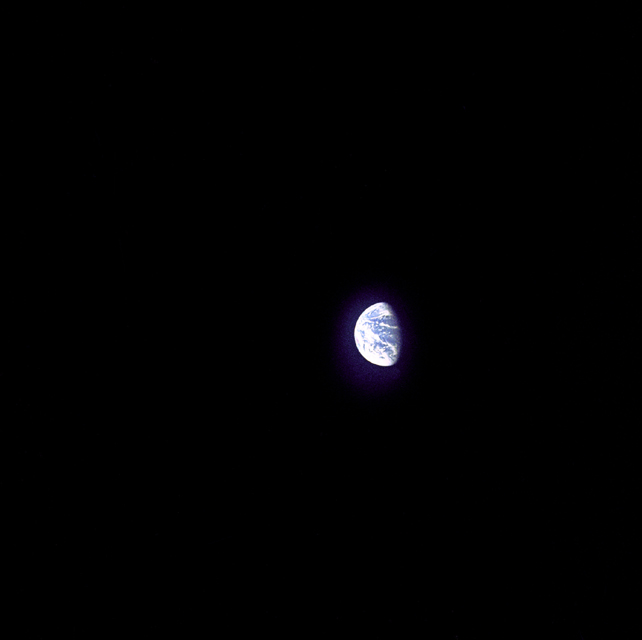
View of Earth from Apollo 17. Image from NASA

There are even more disturbing aspects to this argument.  Who's going to get to go? There are nearly seven billion people here.  Do we really think there can be a morally justifiable process to pick those few?  What traits would we choose?  There is a saying regarding China- if your talents make you one in a million, there are ten thousand people just like you. That would mean seventy thousand just like you throughout the world. Are we willing to deliberately condemn most people to linger on a dying planet while we pour the last of our scarce resources into flinging those few into space?  How could those few live with that decision?  Even worse, what if they could? What would that say about the values and ethics that we chose to propagate beyond our planet's boundaries?

It would take a tremendous investment of resources, including non-renewable ones, in order to succeed.  Even if we decide that we do not care about the moral implications of allowing billions of individuals of our own species, not to mention all the rest of the life forms, to suffer slow death on a ruined planet, why do we think those condemned masses would allow the chosen few to despoil the remaining resources of the planet in order to make their getaway?  And again, the fact that a few might be willing to ruin the futures of so many also says nothing good about the values and attitudes we would be broadcasting into the cosmos.

Unfortunately, this really isn't a hypothetical situation.  There are a chosen few who are already busy destroying the futures of the many, apparently without a single second ethical thought.  Our goal is not to colonize the final frontier, but simply to espouse a lifestyle that happens to extend far beyond our ecological means.  Ironically, it is a lifestyle that frequently leaves us frenetic, sick, and miserable in addition to creating a tremendous delayed cost that our children will have to bear.  The chemistry of our atmosphere, oceans, and even the soils are changing rapidly.  They are not changing in ways that will enhance our survival.  It is sad indeed that ecologists are not at the forefront of sounding the warning, and leading the way in reinventing our society so that we are not committing an act of genocide whose victims will include all of us and our children.

View of Earth from the moon. Image from NASA.

I can imagine that little space capsule spinning out of the Earth's orbit, carrying the seed of incipient disaster to new worlds blissfully ignorant of the fate that awaits them. Out the little window, a message forms in the clouds over the small planet they leave behind:

Do not enter. Toxic dead zone.

Surely we can do better than that.

Friday, May 6, 2011

Swallows

The violet-green swallows are back, wheeling under lowering clouds threatening more winter rain, even though the pasture grass is greening up and the spring wildflowers are defiantly blooming.  These plants are not pollinated by honeybees, but rather by beetles, bumblebees, and other animals less prone to an unusually cold, late spring.
Violet-green swallow, Tachycineta thalassina. Photo by Tom Munson

The swallows are back.  Their internal drives told them to head north into the teeth of cold wind, rain, and hail.  The day I first saw them this year was hardly in the mid-40s, with a sharp-tongued wind laying bare the fragile promise of my jacket.  I wondered if there were any airborne insects for the birds, between the cold and that wind.

These birds spend the northern hemisphere winter in South America, a long way away. They make their way there and back again on those marvelous, fragile wings, guided by the shared hertitage twisted into the strands of their DNA.  We call it instinct, which means we don’t know how they know.  At leas, it doesn’t appear to be knowledge acquired only through the individual’s own experience.

Animal navigation has been the subject of a great deal of human curiosity and research, and we are slowly making headway in understanding the cues that animals use when traveling over vast differences.  Recent work with loggerhead sea turtle hatchlings suggest that the hatchlings use magnetic forces in the earth to find their way, both with respect to latitude, their north-south position, and longitude, their east-west position.  The magnetic field isn’t consistent particularly on the east-west gradient, but the variation through space may be sufficient for the hatchling turtles to recognize their position and make their huge circuit of the Sargasso Sea. 

Loggerhead sea turtle, Caretta caretta. Photo credit: NOAA

Birds also use magnetic cues to find their way.  However, their ability to navigate is also clearly influenced by their experience.  When a biologist captured and transported south-bound starlings en route from northern Europe in the Netherlands and released them in Switzerland, the adult birds compensated for the sideways shift, but the young birds did not.  Juvenile barn swallows responded to magnetic cues when skies were overcast, but didn't do so otherwise. Different birds use different methods of migration, a result of the behavior having evolved again and again. Landmarks and stars and the sun all are used to some extent.  Migrating birds travel enormous distances and risk death if they arrive in the wrong place.  No wonder they draw their navigational information from many sources.

The feat is perhaps all the more spectacular for braiding together multiple lines of evidence, experience, and instinct in a brain we are more likely to mock than admire.  However they do it, I’m glad the swallows found their way back to our pastures again.  Their astonishing flight seems more an aerial celebration than simply a means of survival.