Search This Blog

Sunday, May 13, 2012

Grossbeak Convention

The male evening grossbeak may be one of the most brightly colored birds we overlook right in plain sight.  At least, I always think this in the last week of April and the first two weeks in May, when flocks composed of hundreds of individuals suddenly descend on the center of Oregon State University's campus and spill over into the tall trees in the historic downtown area.  To be fair, the evening grossbeaks stay high in the trees, and their green, black, and yellow plumage, which seems so bright, blends in astonishingly well with the new leaves against a startling sunny sky.  It is as if suddenly someone turned on the color after a long monochrome winter, and all that green and yellow is too overwhelming to pick apart into individual components. 

Photo: J. A. Gervais

Evening grossbeaks aren't wallflowers.  They are big, they are loud, and they are mobile.  But they do like the upper parts of the canopies of the tallest trees, making them somewhat difficult to see.  Binoculars help.  Watching the flocks of grossbeaks inevitably invites watching the crowds of people thronging the campus between classes, to see who else is paying attention, and if anyone else is craning their neck to see the treetop show.

It's hard to tell who actually notices the loud clear calls and buzzy whistles and the rain of empty seed pods wafting down from the heights, but isn't actually trying to look.  There are schedules, after all.  The grossbeaks keep them too, arriving on campus typically in mid-morning, having flown in from the hills northwest of town.  In the late afternoon, they filter back up into those hills, apparently refusing to spend the night in town.  I hear their morning commute while walking the dogs before I commute to town myself.  They fly over in tight flocks, urging each other on with hurry-up calls.  I have no idea if anyone is taking attendance.

I've asked people on campus if they'd like to borrow my binoculars on occasion, if they don't have their eyes fixed to the pavement while moving at warp speed, and if their ears are clear of electronic devices.  Most people have been shyly curious, and delighted when they finally get a glimpse of the handsome males.  These birds look like they belong on the tropics, not on campus with the drab sparrows and juncos that students might ordinarily glimpse on the way to class.  Suddenly there are brighter possibilities afoot, the campus a lot more interesting-  People start to notice the trees and the birds again, if only for a little while.  I take this as a hopeful sign.

Evening Grossbeak, Coccothraustes vespertinus.  Photo: USFWS

Grossbeaks are nomadic, known for their wanderings far out of their typical haunts if good seed years are followed by very bad ones, so that there are too many hungry grossbeaks and a mass exodus ensues.  The flocks around campus come every year with adamant regularity, however, and spend these few weeks frantically eating and courting.  When the speed dating session is over, they disperse; presumably, they're heading into the Coast Range and the Cascade Range to get down to the business of breeding.

How they all know to come through Corvallis, Oregon at this time of year to feed on the seeds of the elms around campus and around town is an open question.  Presumably the juveniles learn by following the older birds, and now there's some kind of tradition- "Let's meet on campus!" followed by, "See you next year!" 
Just as suddenly as they arrived, the grossbeaks leave, the banquet over. I'll still hear solitary, plaintive raspy contact calls in the woods above our farm for a few more weeks, before those too go silent for another year.  Probably the local little brown birds breathe a big sigh of relief to be rid of the big noisy showboats from out of town.

The menu.  Photo: J. A. Gervais

I hope the little brown birds continue to be so overwhelmed every spring, as many parts of the country are seeing declines in these gorgeous finches.  It isn't entirely clear what's going on, because evening grossbeaks get around and don't mind showing up in new places where they may be entirely unexpected.  Their stubborn predictability here is a treat.

Monday, April 30, 2012

Imagine

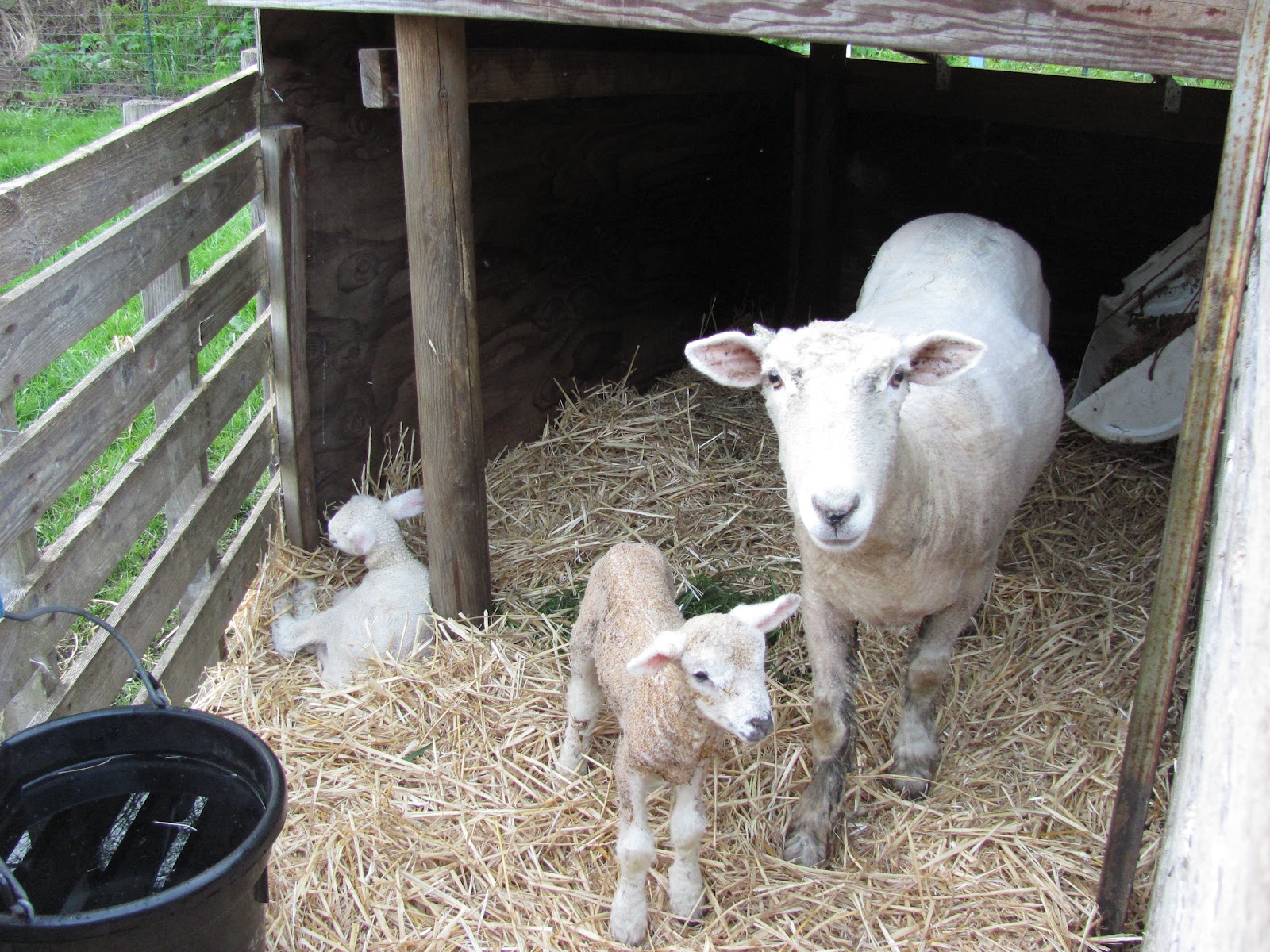
We were trying to herd the sheep into their small three-sided shelter one evening recently, so we could worm the ewes and trim hooves.  It always amazes me how good animals are at reading human body language; they often seem to know what we're up to before we even know ourselves.  Somehow, when the order of business switches from feeding them to moving them around, the sheep recognize it instantly, and they are not always on board with the agenda. They weren't on board this time, behaving as if we were driving them into a dragon's den.

Part of the problem is that sheep really don't like going from bright light into a dark space where they can't see well.  Individually, they enter this shelter on their own all the time, but being pushed as a group made a significant difference in their willingness to enter when we were pressuring them.  Time and again we almost got the lead ewe through the wooden gate, and at the last second she dodged aside, the younger ewes and the lambs quickly following her lead to the far end of the field.  This went on until the light softened with the setting sun, reducing the contrast of the dark interior of the shed.  The old ewe finally decided that it wasn't so frightening in there after all, and led the flock inside.

Photo: J. A. Gervais

Taking the risk of going forward isn't always easy, even if you're a human.

We're facing an unprecedented global environmental crisis because we've modified the atmospheric chemistry enough to begin raising global temperature.  The science behind this fact is well established; the devil is, as usual, in the details.  We don't know precisely at what point increasing carbon dioxide concentrations may begin to force positive feedback loops, whereby the rate of warming is increased still faster.  We do know that this could happen when the frozen methane hydrates in the high-latitude ocean sediments and in the tundra's permafrost begin to melt, releasing large volumes of methane.  Methane is a potent greenhouse gas.

We know that even the deep ocean is warming rapidly.  We don't understand how exactly that will alter ocean currents, or how quickly warmer water will begin releasing the frozen methane in marine sediments, or breaking the ice dams that have stabilized some of the world's largest ice sheets by slowing their entry into the seas. We don't know at what point melting ice sheets will reach a point of no return, where nothing we do could stop the enormous volume of glacial water from pouring into the oceans.  We know from the paleoclimate record that sea level has risen in the past as much as a meter in a quarter century.  We just don't quite understand the exact conditions that would be needed to trigger an event like that again.

But we can guess that we may be getting close.

These are enormous facts, dark facts, rooted in a past most of us cannot imagine and extending into a future that we cannot see, even though that future may be only a few decades away.  Facts fail to resonate with most of us, leaving them in the realm of simply facts, hard-edged, immutable, and seemingly irrelevant to the impulses and instincts that drive most of our behavior.  What does it take to make these inert facts part of our living consciousness?

I wonder if part of the problem is that we don't run forward into the utter unknown very well.  For the vast majority of our evolutionary history, not launching off into the abyss was probably very wise; you take those sorts of risks only when going back or staying where you are is absolutely untenable.  Pushed hard enough, the unknown ahead is less horrific than what you know is behind you, and then you jump.  The trick is recognizing when you are truly at the point of jumping or being pushed, that instant between having some mastery over your fate and losing any hope of control.

 Photo: Jeff Gervais

We may actually be at one of those tipping points, where we could manage to make our planet's climate very difficult for human civilization to persist, at least as we've known it for the last few centuries.  Are we able to perceive that we may have no choice but to accept the fact that the way of life we know now cannot continue, and we can choose, or not choose, to consciously guide its transformation?

Beyond any other species that has ever existed on Earth, we have the capacity to imagine future states and plan out the actions needed to achieve them.  I wonder if our apparent inertia in the face of an increasingly dire body of scientific evidence isn't rooted in two paradoxes.  The first is that although we are intelligent enough to create civilizations that ultimately threaten our own life-support systems, and even to realize it, we seem unable to emotionally grasp and process the enormity of the danger we collectively face.  Rational choice requires emotional roots.  Can an incipient catastrophe carry sufficient emotional weight, or do we have to live through it first?

The second paradox lies in the fact that despite our technological prowess and extraordinary cultural and social diversity as a species, we  appear unable to imagine any other world, any other set of human societies, than the ones we currently know.  So we are caught, unable to emotionally respond to the danger that our current position threatens, and unable to imagine a future different from the present, one that is worth risking the unknown to achieve.  Both block proactive planning and execution of those plans.

Imagine first the world you would like to live in, or the one you would like to bequeath to those who follow you.  What things and beings, tangible or intangible, would this world have in it?  If you listed them all out, how many of them deal with the roots of survival and of happiness, versus the trappings of our civilized lives that bring as much stress or ambivalence as they do real value?  What aspects of our society are most necessary to achieve those core needs?  If no one steps forward to lead us all, how can each of us fill that leadership void, in our own communities, in our own individual way?  How will we break the impasse, and will we manage to get in front of the wave of changes we've unleashed, or allow it to utterly overwhelm us?

Photo: Jeff Gervais


Wednesday, April 18, 2012

Reciprocal Flows

There has been a traditional divide between the worlds of water and dry land in ecology and management, one that has greatly impeded our understanding of the linkages between the two, and long prevented us from realizing, once again, that the artificial divisions we place upon our perception of the world in an attempt to make it easier for us to understand or manage are just that- artificial.  I realized this more fully when I first began to work with the land we owned along the creek north of town.  At first it seemed straightforward enough.  There was creek, and there was upland, and there was only a narrow ragged remnant of forest running along the banks.

It is a fairly short creek, only a few miles from headwaters to its confluence with a small river.  The source is on the major ridge to the north of us.  From there, the creek cuts quickly downslope until it reaches the valley floor not far upstream from us.  The creek slows down a bit there, taking the time to begin to meander, and it supports a nice riparian woodland of bigleaf maple, pacific ninebark and Indian plum, and wildflowers such as delphinium and trillium.  By this point, the creek is big enough to throw a good temper tantrum during a winter storm, and of maintaining a base flow during the summer drought.  Both are important not only to the life of the creek, but to the life of the forest as well.

The riparian zone upstream. Photo: J. A. Gervais

The water doesn't just come from the channel coming down from the north.  There are numerous seeps along this section of the valley, places where suddenly sedges bristle up, where you can sink a tractor up to its axle before you can blink (we've done that).  Fencepost holes sometimes filled with groundwater within minutes, making us rethink the placement of fence lines.  This water is coming from the ridges that run to the west and east, traveling below the surface for perhaps a kilometer or more before bubbling back up into daylight. Some of it likely comes up right in the creek bed.  This is known as hyporheic flow.  It means there's more to the creek than the channel, and that wearing mud boots is generally a good idea even in the meadow.

I've been slowly bridging the divide in my formal education, reading more about just how much a mix of upland and aquatic worlds a riparian zone really is. Large woody debris slows the flow of water, allows sediments to settle, and provides pools.  There isn’t any large wood in our section of creek, because there haven’t been large trees to provide it for many years, and it probably was dragged out if it had fallen in.  There isn’t much of a floodplain here anymore either, because the creek has cut a channel too deep to climb out of in all but the worst floods.  The end result is a truncated system, created from historical misuse.  The floods this past January, however, began to pile up debris and created side channels, the first signs of returning complexity in our section of creek.  Maybe we're getting somewhere, reestablishing the connections between aquatic and terrestrial, past and present.

 Creek bed after the floods rearranged it.  Photo: J. A. Gervais

This patch of land has been farmed for decades.  The last people who lived here rescued abused horses, and fenced in a broad wedge that included the creek.  The horses, over a dozen of them, trampled the banks and stripped the trees, until only a thin, wavering line of vegetation remained.  When the horses left, invasive blackberry thickets grew to over ten feet in height, choking out any hope for new native trees and shrubs.  But this creek has been designated a possible salmon stream, and landowners along the length of it have been encouraged to restore the riparian forest that once graced the length of its banks.

The forests along waterways support the life in the water, which in turns provides resources to the life on land.  Hatches of aquatic insects such as mayflies don’t just feed the fish, but they also support the birds and bats and spiders living along the banks.  In turn, terrestrial insects and plant matter falling into streams and rivers provide major sources of nutrients and energy to the aquatic community.  In fact, one study suggested that nearly half of the annual diet of rainbow trout was made of insects that fell into the stream.  The terrestrial insects are strongly affected by the vegetation along the waterway.  If we wanted to see salmon return, we needed to plant trees.  I had just plunged across the terrestrial/aquatic divide.

 Future ash swale, four years after planting.  Photo: J. A. Gervais

We mowed down the blackberry and with a good number of friends, planted over a thousand native trees and shrubs into the two acres along our section of creek.  Things are looking up.  The planted trees and shrubs have done pretty well, especially the willow.  Even more encouraging, a number of tough volunteers have sprung up from the areas once smothered by blackberry.  We’ve found banana slugs and rough-skinned newts on our property.  We’ve heard frogs in the seeps along its banks and seen fish and invertebrates in the water.  We’re not back to the conditions that existed a hundred and fifty years ago, but they're probably better now than in any point during the past three quarters of a century.  We hope the trend continues beyond our ownership.

Although you can’t stand in the same river twice, the continuum of history and geography shapes the water flowing around your legs.  There is still old farm junk caught in the creek bed, sheets of sediment twisting and crumpling against the bits of rooted rusting iron.  The fence line is new, barely five years built.  When we put the fence in, it was set far enough back that there was easy safe distance from the wire to water.  The creek has looped toward the fence since then, maybe wanting to add more metal debris to its collection.  The creek already reclaimed the lower pasture corner during that violent storm last January, jumping out of its bed and sweeping an arm across the grass, depositing silt from the high ridge.  Remember what's happened before, what came and went, where proud accomplishments failed.

 The tenuous boundaries between terrestrial and aquatic systems. Photo: J. A. Gervais

What we do on the banks of a river affects what happens between those banks, but it’s all pretty temporary in the lifespan of moving water.  In the end, erosion will wear down the divides.


Resources:


Friday, March 30, 2012

Red Hens and Wooden Eggs

We had chickens once before, until a persistent weasel and an interstate move together conspired to eliminate that first flock.  Starting another flock has been on the projects list ever since, and this spring Dan managed to borrow all the equipment necessary for starting chicks.  This led to the building of a sturdy little coop so all would be ready for the moment the as-yet unpurchased chicks grew large enough to need it.  The coop led our neighbor to help us acquire six yearling New Hampshire Red hens that had reached the end of their lives as research subjects at the local university's poultry program.

Dan's not-quite-finished coop.  Photo: D. K. Rosenberg.

Why wait five months for your chicks to mature just in time to stop laying as winter sets in?  We thought these hens would likely be solidly at the peak of their egg production, and the idea of rescue appealed to us as well.  New Hampshire Reds are known to be hardy birds with a proclivity for brooding.  This is handy if you have a rooster and a desire to keep your flock growing with some new broods of chicks occasionally.  A few days later six refugee hens came home in an assortment of cat and dog transport crates to begin new lives on our little farm.

The university raises chickens according to industry standards.  This means each hen had spent her days in a small cage just big enough for her to turn around in, with a sloped wire floor.  When an egg is laid, it rolls down into a collection chute.  It is possible that these hens never get to inspect an egg up close.  They also don't get to give their wings a good stretch, scratch and peck on the ground, perch, or engage in a lot of other typical chicken behaviors.  We wondered how they would adapt to a barnyard.

We kept the hens confined to the coop for several days to adjust to their new life as real, live chickens rather than industrial egg production machines. Our coop is small but it was still much more space than they'd had for most of their lives, and included a window with a view of the sheep pasture, branches to perch on, nest boxes, and a layer of shavings to scratch in.  It must have been a staggering change.

A whole new world... Photo: D. K. Rosenberg

Instinct, that knowledge we hold without thought or learning, is a powerful force.  A hen kept her entire life in an indoor facility under artificial lighting in a small cage still knows what to do when she's presented with a patch of dirt and grass.  The first day we opened the door, the chickens learned to navigate the ladder to the ground, and soon all were pecking, scratching, clucking, and interacting as if they had never been anywhere else.  Except for one crucial detail: they did not recognize their own eggs.

A challenge in backyard chicken husbandry is to prevent your chickens from ever learning what good food eggs can be.  If the shell cracks and a hen takes an exploratory peck, she'll enthusiastically eat the whole thing, shell and all.  Once she sees an egg in this light, there seems to be no going back.  We quickly discovered that our six hens had no idea what to do with eggs, laying them carelessly around the coop and outside in the mud.  Very soon after that, despite our constant checks to remove the eggs as quickly as possible after they were laid, at least one chicken took an exploratory whack.  We haven't gotten an egg since.

I tried to break the habit or at least prevent all the hens from learning it by stocking the coop with some wooden eggs I acquired from a craft store selling Easter supplies.  Unfortunately, the reward of hitting a real egg seemed too great to discourage a hen who simply came up with a jarring thud when she explored the possibilities of one of the wooden ones.  Dan watched one hen attack a decoy egg so savagely that she pushed it halfway around the coop.  Motherhood was clearly not in her future, nor in any other hen's future if the infanticidal chicken remained part of the flock.

Wooden eggs.  Photo: D. K. Rosenberg

Of all the instincts that constrictive captivity had broken, it was the one most critical to the long-term survival of the species: thou shalt not eat thine own children.  The drive to reproduce is so strong that many animals risk their lives to mate or defend their young, or push themselves to the point of starvation to provide for them.  It is sobering to think that we have managed to subvert the basic wiring of being a chicken to the point it cannot recognize its egg as its own.

This isn't the worst we've done.  Meat chickens are bred to grow so quickly that their legs sometimes become unable to bear their weight.  The feeding of corn to beef cattle during the final stage before slaughter is a carefully managed balance between initial weight gain on this highly unsuitable diet, and weight loss once the acidity of the rumen caused by the corn begins to dissolve the rumen lining.  Concentrated Animal Feeding Operations, or CAFOs, are notorious for the conditions in which individual pigs and other animals are kept, not to mention the significant issues of air and water pollution from the staggering amount of waste you get when you keep tens of thousands of animals in a very small space.

What do we owe the livestock we rely on for meat, milk, and eggs?

The backyard food movement is certainly driven at least in part by peoples' desire to take more control over how their food is produced.  This is a good thing in a culture that has become increasingly alienated from the life forces that sustain our own, even if the motivation is only rarely the welfare of the soil, plants, and animals.  In an increasingly crowded world, however, not everyone will have the luxury of space, good soil, and clean water plentiful enough to raise food of any sort.  We're still going to need large, efficient farms at some scale.

All the same, awareness will at least keep us honest in our obligations to the animals that feed us, to keep them fed, sheltered, and provide them with the opportunity to express the most basic essence of what they are: living beings.  At what price to our own humanity do we want cheap bacon?

Five hens still scratch and peck underneath the new coop, ignoring the sheep who come by every evening to take a look at them.  They may yet complete the transition into a hardy little productive flock for us; we'll give them more time to settle in to their new world.  Whether they provide us with eggs or meat, we'll be grateful for the gifts of their lives, sustaining ours.

Photo: D. K. Rosenberg

Sunday, March 18, 2012

The various contrivances of orchids

I joined the local orchid society this winter.  The months of soggy dark require unusual coping measures at times; the displays of blooming orchids on the "show and tell" table at the monthly meetings alone are worth the membership.  My own little collection isn't doing too badly.  My phalaenopsis and paphilopedilum are blooming, and the zygopetalum's buds are swelling steadily. 

Phalaenopsis, known as the moth orchid.  Photo: J. A. Gervais

Orchids make up the largest plant family on the planet, with about 24,000 species.  They live in a staggering array of environments, from the tropical rainforests most of us associate with them to tundra environments, in the deep shade and out in the open sun, perched in trees or on the ground.  They are united, however, in their extraordinary biology, making use of an incredible array of other organisms to help them through their life cycle.

The local orchid society has about thirty members, small enough that guests are immediately recognized as such and welcomed with enthusiastic delight.  How do you not join a group of people who love to talk about flowers?  The skill level ranges from experts who hone their skills cultivating the most challenging plants, to people like me who can kill just about any orchid effortlessly.  I suspect the experienced growers look on us neophytes as a great way to clean out the clutter of their greenhouses: giving an extra orchid to someone who at least admires it seems less heartless than throwing it straight on the compost heap.  I view it as a type of symbiosis, although the plants may not.

Orchids have developed trans-species  interrelationships to a remarkable degree on several fronts.  The seeds require the services of a mycorrhyzal fungus in order to germinate, relying on the fungus to make up for their lack of endocarp.  Many species are epiphytes, perching on the trunks and branches of larger plants.  The pseudobulbs of other orchids harbor ferocious ants that offer protection to their hosts.  Most noteworthy, some orchids have developed extraordinary coevolutionary relationships for pollination.


Anagraecum sesquipedale.  Charles Darwin hypothesized that this magnificent orchid is pollinated by a hawk moth.  The moth, Xanthopan morganii, wasn't discovered for another 41 years, and proof of pollination services had to wait 130 years after Darwin's insight.

Although many flowering plants have built relationships with animals for the purposes of both pollen delivery and seed dispersal, orchids have gone to extremes.  The pollen of the vast majority of plant species is released as a dust of individual grains, but in nearly all orchids pollen is wadded up into two to twelve waxy balls, called pollinia.  It's a high-risk strategy, because each flower on the plant (and many produce only a single flower) has exactly that many chances to fertilize another plant's flowers for seeds.  It's a twist on putting all of one's eggs in a very few baskets.

The pollinia are designed for long-distance transit.  Pollinia on hawk moths in the wild have remained stuck in place and ready for deposit for over three weeks.  Insects, birds, and moths that visit orchids may have multiple pollinia stuck to their heads, beaks, and proboscuses like yellow bunny ears.  Different species of orchids place their pollinia in slightly different positions on the pollinator, ensuring correct delivery when the animal visits the appropriate orchid species again. 

This trait can be quite useful for someone interested in propagating orchids, and in creating new hybrids.  It isn't hard to use a pencil or other pointed object to lift the pollinia free of the flower column; they will quickly bind tightly to the object and orient themselves for maximum contact with the receiving flower's stigma.  It is a system easily manipulated by people.  In fact, we're the only mammal that pollinates orchids.  Once fertilized, the flowers quickly wilt.  This, announced my high school biology teacher with a wicked grin, opens up interesting possibilities if you don't like the prom date to whom you are expected to offer an expensive orchid corsage.

The flowers are all about sex, as all flowers are, but for some orchids it's a double entendre.  The sneakiest orchids are those whose flower parts have evolved to resemble female insects, complete with a release of chemicals that mimic the insects' own pheromones.  The strategy is known as pseudocopulation, as the befuddled male insect attempts to copulate with the flowers, and gets tagged with a pollinium for his pains.  Presumably he either doesn't learn, forgets quickly enough, or becomes desperate enough to visit another orchid of the same species before he dies.  The odds are long, and because of that the flowers remain intact for many weeks.  This is, of course, one of the characteristics that makes them so irresistable to humans bent on romance. 

The aptly named bee orchid, Ophrys apifera.  It is pollinated by male bumblebees and is an example of pseudocopulation.  Photo by Nancy Cottner


Not all orchids try to forgo paying the pollinators for their services through deceit.  Many offer nectar, which varies in sugar concentration depending on the pollinator. Specialized avian pollinators such as sunbirds earn the highest reward; hawk-moth-pollinated flowers offer a somewhat lower sugar level, and the least concentrated nectar is payment to the least-specialized pollinators from the more generalist orchids.  Within the flower, the most concentrated nectar is the farthest in, encouraging a good push to obtain the reward, and maximum contact with the pollinia.  Other orchids offer scents or waxes and resins that are gathered by their pollinators.

My fellow orchid enthusiasts range from generalists who do not seem to have ever met an orchid they didn't like, to those who specialize on one small subgroup.  Some folks seem taken up entirely by the challenge of the cultivation of the most exacting varieties, whereas others of us are unapologetic fans of the lowest-maintenance plants that reliably produce bright, interesting blooms with the least amount of fuss.  We're all in it for the flowers. 

For all their trickery and bribes, less than one in five tropical orchids typically achieves fruit set in the wild.  Pollination is generally thought to be the limiting factor for reproduction in wild orchids, even with their absolute dependence on fungi for seed germination.  Wild orchids are perhaps most amazing in the fact they exist at all, let alone having successfully woven themselves into the ecological fabric of so many places.

The orchids on the monthly show and tell table are often so hybridized by human breeders that the names of the crosses don't always fit on the plants' tags.  These are organisms of the greenhouse and windowsill, depending on the passion, space, and financial allocations of the owners.  I asked one of my fellow club members how many plants he had.  "Seven hundred, I think," he answered.  "I have two greenhouses now.  We all started with a few orchids on a windowsill."  Orchids have been amazingly successful at bending yet another species to the task of continuing their existence. 

I swear my little collection isn't going to need more space than my windowsills.  Soon, after the peas have sent up tendrils and the lambs have all been born, I'll be out in the woods hunting for my favorite orchid: Calypso bulbosa, which grows in heavily shaded understory, and tricks bumblebees into pollinating it.  I don't have to do anything at all, except admire it and the extraordinary ecological relationships that sustain it.  I don't think, however, that either the club members or their orchid masters have given up on me.

Calypso bulbosa.  Photo: J. A. Gervais

Sources:

Boyden, T. C. 1982. The pollination biology of Calypso bulbosa var Americana (Orchidacea): initial deception of bumblebee visitors.  Oecologia 55(2):178-184.

Cozzolino, S., and A. Widmer.  2005.  Orchid diversity: an evolutionary consequence of deception? Trends in Ecology and Evolution 20(9):487-494.

Darwin, C.  1882.  The various contrivances by which orchids are fertilized by insects. 2nd Edition, Revised. London: John Murray.

Micheneau, C., S. D. Johnson and M. F. Fay.  2009.  Orchid pollination: from Darwin to the present day. Botanical Journal of the Linnean Society 161:1-19.

Tremblay, R. L., J. D. Ackerman, J. K. Zimmerman, and R. N. Calvo.  2005.  Variation in sexual reproduction in orchids and its evolutionary consequences: a spasmodic journey to diversification.  Botanical Journal of the Linnean Society 84: 1-54.


Sunday, February 26, 2012

The Balance of Voles

The barn owls will be nesting very soon.  They've already started the process of dating, the males bringing Valentine's gifts of dead voles to their prospective mates and spending the daylight hours together tucked safely away in a dark corner somewhere.  If the female likes the gifts and the company, she'll soon begin laying her white eggs, counting on the male to provide all the food for her and then the entire family for weeks to come.  Hundreds of voles will be consumed in the process.

Some years ago, I provided some dark corners in the form of nest boxes to see if barn owls might help the local farmers with the ebb and flow of wild voles, which can cause thousands of dollars per farm in crop damage in a peak year.  I put out eighty boxes spread between two counties, in strings of three to five boxes per fence row.  The study finished several years ago, the funding gone, the results inconclusive, but the boxes are still standing.  To help out both the owls and the farmers who gave me access to their lands, I go out each December and maintain the boxes.

Barn owl nest box.  Photo: J. A. Gervais

Farming must be the most difficult form of legalized gambling, where those who farm have to work very hard, in often physically demanding and dangerous conditions, in hopes of producing a crop that can then be sold at a profit.  Almost nothing in this process seems to be in the farmer's control beyond the calculated decision of what to plant.  More so than any other livelihood directly linked to natural resources, farming is a long-term gamble, a balance of good weather and not too many pests, then favorable market conditions.

Barn owls rely on small rodents for their living.  The females will lay up to thirteen eggs, although the average clutch is closer to five eggs.  They hedge their bets by incubating during laying, so the eggs hatch over several days and the young owlets range in size.  The biggest owlets eat first.  In a pinch, they'll eat their younger siblings if the parents do not bring enough voles.  In the best of years, the adults will raise a second brood.

The farmers I work with like wildlife, and do what they can to accommodate the owls while they also pursue a precarious living.  Far more than most professions, farming reminds us that nature is ultimately in control, and we all rely on good weather, healthy soil, and clean water far more than most of us remember.  For a farmer, it is each year's bottom line, the balance between inputs and outputs tipping precariously on the edge of the appetites of voles.  Unfortunately, the appetites of owls are not great enough to swing the balance on the bad years, but they help.  Barn owls nesting in a barn make a mess but are usually tolerated.  Barn owls in a nest box are universally welcomed.

Cleaning out a nest box.  Photo: J. A. Gervais

The necessary maintenance of a barn owl box requires cleaning out the detritus of the past year, occasionally making repairs to the flap, or reinforcing the connection point between box and post.  Although natural cavities may fill with nesting material and prey remains over the years without much problem, the weight of all that material in a box that leaks a bit is much too great to be allowed to build up over time.  Armed with a gardening hand rake and a face shield, I open the flap, reach inside, and haul out all manner of rubbish into the dim December light.  It is a messy act of renewal.

My assistants are frequently showered with starling nests, great wads of sticks and straw that nearly fill the generous cavity.  It is usually raining, so the rain gear we wear serves a dual purpose.  Other unknown inhabitants bring bits of lichen and moss, or a few strands of grass.  Kestrels leave almost no traces of their nests, and a box used as a roost by barn owls may give no hint of its sometime occupants.  In a year with abundant voles, sometimes a vole carcass or two comes cascading out of the box, often with little else; we put those back, as they were put there by someone as a hedge against hard times.  Sometimes deer mice take up residence, bringing a light fluffy mass of shredded bark and leaves inside.  Others are empty except for a the abandoned comb of the paper wasp.  A barn owl nest, however, is an entirely different story.

Inside a barn owl nest box.  Last year's abandoned egg sits on the remains
 of hundreds of voles.  Photo: D. K. Rosenberg.

For those, I whack away with my hand rake at the thick, compacted mat of fur and bones and nameless dried goo, cemented in layers if the box is in the lee of some trees, a wet sodden mass if the rain can get inside.  Sometimes we find the remains of a young owl that did not survive the nestling period, or an unhatched egg now dessicated and filthy.  There is some satisfaction to getting all that mess out of the living quarters, leaving things ready for another year's accumulation.  Farmers, meanwhile, maintain tractors and other equipment, and soon they too will be getting down to the business of the year in the fields.

It is hard to leave a warm house on a cold, wet December morning before dawn to spend the day plodding along the fence lines in the rain carrying a ladder for miles.  There are compensations.  Sometimes we're given beautiful views of light and cloud, the song of a flock of swans, the calls of killdeer or snipe, and occasionally, the silent explosion of a white and fawn barn owl, as it exits the box just as I raise the flap.  There's time for the owl to get over the fright before the decision of where to lay must be made.  There is still time to plan out the new year, room for hoping for a good harvest and the right balance between voles and owls and people, all counting on the green grass in the fields.

Thursday, February 16, 2012

Of Love and Dancing

The albatrosses began to return in late October.  One day I looked out from our cook tent and there were perhaps a half-dozen of the huge white birds standing serenely on the sand, looking both grave and comical with the stark, sharp beauty of sea-gray wings folded crisply across their backs.  They waddled uncertainly over the dunes to just the right spot, there, that's the nest, right there.  A few days later, there were hundreds, and a week later, thousands.  Their season on the tiny speck of sand in the middle of the Pacific had begun.


 Laysan albatrosse pair on Laysan Island.  Photo: J. A. Gervais, 1992

You can find Laysan Island on most world maps, although it is only about a mile and a half long, a mile wide, and cradles a large super salty lagoon.  Essentially it is nothing more than a large sand dune perched on a remnant volcano.  There isn't much else out in this part of the world, a thousand miles northwest of Honolulu, and Laysan is the second largest of the Northwestern Hawaiian Islands.  For a few years over a century ago, it was inhabited, briefly, by humans, who mined the guano, harvested the albatrosses' eggs, and killed the birds for their feathers.  It has belonged to the birds for many thousands of years.

Land is a rare commodity in the middle of the ocean, and all seabirds are tied to it for breeding.  The birds of Laysan do a time-share, where different species come in from the far reaches of their wanderings and breed at different seasons.  Winter belongs to the bonin petrels, the black-footed albatrosses, and Laysan albatrosses.

Blackfooted albatrosses dancing, Laysan Island.  Photo: J. A. Gervais, 1992.

The albatrosses were mostly quiet at first.  It must be very strange, to land on unyielding ground for the first time in nine months, and the newest arrivals seemed to suffer from the same "sea leg" syndrome that people do.  They wobbled around and studied the clumps of bunchgrass and their neighbors in silence.  But as the few birds swelled to thousands, the singing and dancing began in earnest.

Albatrosses dance.  These are spectacular dances, involving wild bows and snapping beaks, with some individuals becoming so excited they gape and scream, whipping their heads back and forth.  They whinny and moo and clap that huge beak.  Sometimes they throw themselves up on tiptoe and point skyward, with a soulful moan at the apex.  The black-footed albatrosses have a different dance than the Laysan albatrosses, but both dances are exotic, energetic, and incredibly noisy.  Living on a colony numbering tens of thousands of pairs is like being in the middle of a demented barnyard.

Laysan albatross skypointing.  Photo: J. A. Gervais, 1992.

We quickly learned that young albatrosses were so anxious to get going with their adult lives that they would throw themselves into a frenzied performance if we just waved two fingers back and forth in front of them, mimicking the first moves of the dance.  When we failed to deliver the correct response partway into the performance, they would retreat hastily, looking flustered.

I tried coaxing a few of the pairs who settled into spots right around my tent into a cross-species tango.  These birds' mates had already arrived, and after a few passionate rounds of dancing it seemed that old ties were renewed well enough to get down to the business of breeding.  Waving fingers in front of these birds elicited a sidelong look.  The albatross would draw in its chin, that huge, hooked beak held down along its neck, and waddle emphatically away.  Sometimes interspecies communication is shatteringly clear.

Every now and then, a Laysan albatross and a black-footed albatross mate, and raise a chick.  The chick, however, is doomed to be completely unlucky in love, because its dance is stuck halfway between the species.  Nobody seems to want a partner who can't do all the right moves.  The vast majority of birds belong to one species or the other, however.  Nearly all find a partner and stay together for many years, renewing the relationship each autumn with the ritual of the dance.

Blackfooted albatross dance on Laysan Island.  Photo: J. A. Gervais, 1992.

I worked on Laysan for a magical four months, picking away at invasive grass that provided shelter for none of the birds, but crowded out the native bunchgrass that nearly all of them need.  Although the work was far from special, sneaking by sea turtles and monk seals, admiring the antics of boobies and albatrosses, and watching tropicbirds and frigatebirds engage in aerial warfare made even plodding over sand dunes carrying backpack sprayers full of herbicide the best job I ever had.

I left Laysan Island on a November morning nearly twenty years ago, and I still dream sometimes of the intense color of the sea, the enormity of the sky, and the noise of all those birds.  It was an early love, one you don't forget, even if you go on to fall in love with many other places.