Search This Blog

Thursday, May 19, 2011

Lost in Space?

I was scanning the pages of a scientific journal one evening and fell upon a guest editorial that made me fall out of my chair. Two scientists from a respectable institution suggested, with all apparent sincerity, that the best way to avoid the extinction of humanity would be to colonize outer space. 

This immediately brought to my mind the image of the interstellar community frantically deploying some kind of cosmic germ killer to deal with the infectious blob spinning off from our mortally wounded biosphere.  What have we done here to deserve welcome anywhere out there?  Our record of stewardship is not good.  We have not been kind to any life forms that have had the misfortune to be present when we have colonized new territory- not even members of our own species.  Those of us left behind could only hope that any life forms out there would not have a view of epidemiology that included going after the source of the incipient infection.

Venus bus probes, image from NASA.


Humor aside, there are some very troubling aspects to this argument.  I was surprised and disappointed that such a view could be espoused in an ecological journal.  Ecologists, of all people, should appreciate the intricate, invisible bonds that tie us to the biosphere of this planet.  The history of the evolution of this biosphere is inseparably bound within us, from the micro nutrients we need, our bodies' metabolism, and the bacteria that live in our digestive systems to our circadian rhythms, set by the sun as we move around it with our planet Earth.  We have proven we can survive, briefly, out of the context of our world, but do we really have the arrogance and hubris to believe we can recreate everything we need somewhere else, when we have only the shallowest understanding of the interrelationships here that sustain us?  Ecologists should know better.

Home Sweet Home
View of Earth from Apollo 17. Image from NASA

There are even more disturbing aspects to this argument.  Who's going to get to go? There are nearly seven billion people here.  Do we really think there can be a morally justifiable process to pick those few?  What traits would we choose?  There is a saying regarding China- if your talents make you one in a million, there are ten thousand people just like you. That would mean seventy thousand just like you throughout the world. Are we willing to deliberately condemn most people to linger on a dying planet while we pour the last of our scarce resources into flinging those few into space?  How could those few live with that decision?  Even worse, what if they could? What would that say about the values and ethics that we chose to propagate beyond our planet's boundaries?

It would take a tremendous investment of resources, including non-renewable ones, in order to succeed.  Even if we decide that we do not care about the moral implications of allowing billions of individuals of our own species, not to mention all the rest of the life forms, to suffer slow death on a ruined planet, why do we think those condemned masses would allow the chosen few to despoil the remaining resources of the planet in order to make their getaway?  And again, the fact that a few might be willing to ruin the futures of so many also says nothing good about the values and attitudes we would be broadcasting into the cosmos.

Unfortunately, this really isn't a hypothetical situation.  There are a chosen few who are already busy destroying the futures of the many, apparently without a single second ethical thought.  Our goal is not to colonize the final frontier, but simply to espouse a lifestyle that happens to extend far beyond our ecological means.  Ironically, it is a lifestyle that frequently leaves us frenetic, sick, and miserable in addition to creating a tremendous delayed cost that our children will have to bear.  The chemistry of our atmosphere, oceans, and even the soils are changing rapidly.  They are not changing in ways that will enhance our survival.  It is sad indeed that ecologists are not at the forefront of sounding the warning, and leading the way in reinventing our society so that we are not committing an act of genocide whose victims will include all of us and our children.
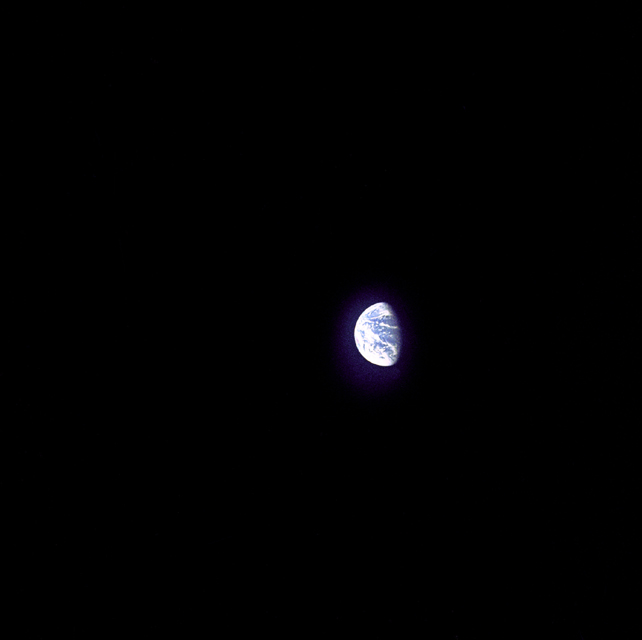
View of Earth from the moon. Image from NASA.

I can imagine that little space capsule spinning out of the Earth's orbit, carrying the seed of incipient disaster to new worlds blissfully ignorant of the fate that awaits them. Out the little window, a message forms in the clouds over the small planet they leave behind:

Do not enter. Toxic dead zone.

Surely we can do better than that.

Friday, May 6, 2011

Swallows

The violet-green swallows are back, wheeling under lowering clouds threatening more winter rain, even though the pasture grass is greening up and the spring wildflowers are defiantly blooming.  These plants are not pollinated by honeybees, but rather by beetles, bumblebees, and other animals less prone to an unusually cold, late spring.
Violet-green swallow, Tachycineta thalassina. Photo by Tom Munson

The swallows are back.  Their internal drives told them to head north into the teeth of cold wind, rain, and hail.  The day I first saw them this year was hardly in the mid-40s, with a sharp-tongued wind laying bare the fragile promise of my jacket.  I wondered if there were any airborne insects for the birds, between the cold and that wind.

These birds spend the northern hemisphere winter in South America, a long way away. They make their way there and back again on those marvelous, fragile wings, guided by the shared hertitage twisted into the strands of their DNA.  We call it instinct, which means we don’t know how they know.  At leas, it doesn’t appear to be knowledge acquired only through the individual’s own experience.

Animal navigation has been the subject of a great deal of human curiosity and research, and we are slowly making headway in understanding the cues that animals use when traveling over vast differences.  Recent work with loggerhead sea turtle hatchlings suggest that the hatchlings use magnetic forces in the earth to find their way, both with respect to latitude, their north-south position, and longitude, their east-west position.  The magnetic field isn’t consistent particularly on the east-west gradient, but the variation through space may be sufficient for the hatchling turtles to recognize their position and make their huge circuit of the Sargasso Sea. 

Loggerhead sea turtle, Caretta caretta. Photo credit: NOAA

Birds also use magnetic cues to find their way.  However, their ability to navigate is also clearly influenced by their experience.  When a biologist captured and transported south-bound starlings en route from northern Europe in the Netherlands and released them in Switzerland, the adult birds compensated for the sideways shift, but the young birds did not.  Juvenile barn swallows responded to magnetic cues when skies were overcast, but didn't do so otherwise. Different birds use different methods of migration, a result of the behavior having evolved again and again. Landmarks and stars and the sun all are used to some extent.  Migrating birds travel enormous distances and risk death if they arrive in the wrong place.  No wonder they draw their navigational information from many sources.

The feat is perhaps all the more spectacular for braiding together multiple lines of evidence, experience, and instinct in a brain we are more likely to mock than admire.  However they do it, I’m glad the swallows found their way back to our pastures again.  Their astonishing flight seems more an aerial celebration than simply a means of survival.

Monday, April 18, 2011

One Becomes Three

Our old ewe decided to do us a favor and drop her lambs in the middle of a relatively pleasant Sunday afternoon, when we would be easily available to help her out.  She's taken advantage of our assistance during the two previous lambings, even when the lambs are lined up nicely without tangled legs or twisted heads, and ready to go with a good push.  Buttercup doesn't seem to want to push anymore.  Maybe she's decided she's too old for heroics when there is help available.  She's a wise old sheep.

Dan begins the assist, drawing on the front legs of the lamb.

The lamb is almost out.  They are incredibly slippery.

Touchdown!

First wide-eyed look at a new world.

Buttercup does her stuff.

With an assist, the new lamb is soon delivered onto the straw, and the old ewe immediately begins cleaning off the membranes and fluid, rasping steadily with her rough tongue and chuckling away.  Sheep have a special gutteral bleat they use just for their newborn babies.  The lamb soon answers, a high-pitched protest.  What must it be like, to go from tight hot darkess, into cold bright light and too much space in a matter of seconds?  The lamb works to rise, stumbling and flopping forward and sideways.  She soon has mastered tucking her shockingly long legs tight under her body, and within a few minutes of that, she can rise and stand.  At this point, we deliver the second lamb, and while Buttercup begins another round of cleaning and chuckling, the first lamb finds her udder, and after several long minutes of apparent confusion, she takes her first meal of rich milk.  The second lamb soon follows.

Despite thousands of years of domestication and intense selective breeding, they all know what to do.  It is easy to understand the need for a wild lamb to quickly climb to its feet and feed, and be ready to either run or hide within minutes of its birth.  It is harder to imagine the slow steps along that evolutionary journey, the process of encoding these complex behaviors into genes piece by piece.

This morning we only had one sheep, our old ewe with her low-hanging udder and enormous swollen body, standing a bit dejectedly by the fence.  The ewe is now fired up with a new purpose, both protective and nuturing, carrying on the instructions that have carried life through the ages.

So one became three.

Postscript. This morning I rode my bicycle by the pasture at dawn, and saw Buttercup resting in the shed with her two lambs curled up in tight black commas beside her.  It was cold last night, with a light frost.  Imagine your first day, watching an overcast afternoon fade into nightfall and cold moonlight.  You keep warm by pressing one side of yourself into your dam, while the little meal of milk that is all your stomach can hold has to fire up your body heat, something you've never had to do for yourself before.  What is that like for a lamb, or any other newborn animal that is born aware of its surroundings?  The sun was just edging up over the ridge when I saw them this morning, washing the hilltops with the promise of a day without rain.  The lambs looked out from their shelter at their lives opening out before them.

Sunday, April 10, 2011

Soundscapes

I bought a small tape recorder recently, and decided to record the chorus of Pacific tree frogs in a nearby wetland next to our road.  I chose a nice warm rainy night and the frogs obligingly sang their hearts out, for love, for mates, for genetic fitness, maybe just for the sheer joy of it.  Whatever the reason, they filled the darkness with their urgent sound.

I couldn't record for more than a minute or so before the performance was interrupted by the sounds of tires on wet pavement, leaving a lower-intensity backwash of sound in the vehicle's wake.  The frogs kept singing through most of the interruptions, which was a good thing or they would have lost much of their stage time even on this relatively quiet dead-end road.  It got me thinking of how all the racket we make affects other organisms.

Pacific Tree Frog, Pseudachris regilla.  Photo: thewakingdragon


We are a visual species, despite using sound extensively for intraspecific communication.  If you sat down and described your favorite place, would you include sounds at all?  Even when we talk about concepts, we use visual imagery: as you can see from the big picture, if we took the long view, we could see the problem through to its logical conclusion.  We don't even have the language for a soundscape.  Do we call it the big audio?  The whole noise?

Bryan Pijanowski and four colleagues explore the ecology of soundscapes in a review article recently published in the journal Bioscience. The basic working idea is captured by the Sender-Propagation-Receiver model, where the sender's biophysical characteristics and intent shape the form of the message.  The message may be further modulated by its passage through the physical environment, and its ultimate effect depends on the perception and interpretation of the recipient.  The male frogs' individual success not only depends on the quality of the competition, but also the ability of their calls to carry successfully to the ears of female frogs who will undersand the message- and respond as the males desperately hope they will.

Pacific tree frog, Pseudachris regilla, singing. Photo: GregTheBusker

You can also break sounds down into three general categories.  Geophony describes the sounds of the natural environment that are from physical processes.  Think of the sound of wind hissing across long grass, the sharp pure crack of rockfall, or the extraordinary sound of moving water.  Biophony are noises made by living organisms, although Pijanowski and Company seem to reserve the term for non-human organisms.  Birdsong is obvious; the sounds of a slug munching vegetation, or the whir of a beetle's wings, a little less so.  Finally, the sounds made by Homo sapiens are classed as anthrophony.  It is probably a relevant distinction, because even though we're very much a part of the biological fabric, the vast majority of the noise associated with us is empty of meaning.  Think lawnmower, or air conditioning, or the sounds of vehicles on wet pavement.  That's not to suggest chewing slugs are communicating, but the noise is relevant to slug predators such as ground beetles or garter snakes.

Do we affect the natural world with our racket?  There is a great deal of concern now about ocean noise pollution interfering with the communication and navigation of marine life.  European robins shift the timing of their song in noisy environments.  Song sparrows shifted the lower-frequency notes upwards in their songs, and great tits use higher pitches when confronted with more ambient noise.  In short, the din of civilization has an impact, one we are just starting to recognize and measure.

Song sparrow, Melospiza melodia.  Photo by Alan Vernon


Our cacophony of meaningless noise may have another undesirable effect, this one on us.  We fill our leisure time with the sounds of music or podcasts or television, which have become so portable we can take them right into the very heart of biophonic and geophonic symphonies in progress.  Hearing loss is so obvious and so well publicized it hardly bears mentioning.  But, if we navigate our world by cultivating the skill of blocking out the sounds surrounding us, how well can we listen and actively hear when confronted with an environment that demands it?

Fortunately, very few of us need worry about the signals of natural sound.  We might miss the sudden snap of a branch broken by the deer, the liquid silver of moving water, or the sex calls of frogs, but our lives don't immediately depend on our hearing those signals.  But, by choosing to venture into natural environments without opening ourselves to one of the major dimensions of experience they offer to us, we do perhaphs further alienate ourselves from our biological roots.  Further losing our sense of place on this small planet may not be a matter of just making meaningless noise.

Thursday, March 31, 2011

An Ode to Voles

It's time to plant my peas, but I've been watching a series of holes appear around the foot of my garden's raised beds that suddenly began to appear in Februrary.  It looked like the lawn was undergoing a slow-motion boil, but in each spot where a bubble popped, a vole burst forth leaving a new burrow system behind it.  They've got their own plans for my vegetables, I'm afraid, because at least one new tunnel opened right into the bed itself among some overwintering beets.

Time to set some snap traps in the garden beds, and I've already sheathed our young orchard's tender trunks in hardware cloth.  Even as I take defensive action, though, I have to admit I admire these animals greatly.  An ounce or three of fur and digestive system, taken in the whole, has a tremendous impact on the ecosystem.

Gray-tailed vole, Microtus canicaudus. Photo by Jerry Wolff

Voles have fascinated ecologists for over a century with their high-latitude cycles of boom and bust; it's been a hundred years and literally thousands of scientific papers and we still don't really understand what drives those catastropic plunges in density that inspired the legend of mass suicide by drowning.  We are, however, making progress.  Regardless of what happens to the majority of them, a few voles survive the cataclysm, and the start of another wave builds from those survivors.

It turns out that the wave analogy is actually a very good one.  A number of organisms, from larch bud moths and pine beetles to voles and lynx, seem to display population dynamics that can be modeled as waves moving across the landscape.  There are a number of recent papers in the scientific literature by Jonathan Sherratt and others that apply the mathematics of periodic travelling waves to the population dynamics of animals.  Leaving the mathematics behind for now, imagine a wave of animals rising up on the landscape, their impact rising with their numbers, then abruptly dropping down as the peak of the wave moves on.  You can actually view a simulation of these waves on Dr. Sherratt's website.

When voles explode, they provide a ready protein source that is exploited by every carnivorous or omnivorous animal able to swallow them.  Some animals, such as the snowy owl and the least weasel, seem to be quite tied to the cycles of their prey; others are blatant opportunists.  I studied burrowing owls for many years.  The year the California vole populations were so dense I could sit on the cab of my truck and actually hear them grazing, the burrowing owls raised up to 11 young per pair.  The result: a wave of young predators spreads from the wave of available food, spreading concentric rings colliding and melding across the landscape.


Burrowing owl young. Photo: D. K. Rosenberg

Voles are small, but their numbers during a peak year can be impressive: estimates of voles' maxium densities run from 3,000 to 25,000 per hectare.  That works out to roughly three-quarters of a ton of small herbivore per acre.  Henry Howe and his colleagues put out exclosures in a prairie system and demonstrated that vole herbivory greatly affects the plant community.  What that study didn't consider is the dynamic nature of that herbivory as the populations crest and trough in any particular place.  So, imagine that wave sweeping over the landscape again, perhaps leaving behind distinct age classes in the vegetation.  I'm not sure anyone's looked for that yet.

Voles don't just eat and get eaten; they also dig and poop and pee.  Anyone who has ever looked after 750 pounds of herbivore living in a barn knows how much manure can be produced out the back end by non-ruminants especially, where so much of the bulk is passed undigested.  Voles dig, depending on the species; I've counted ten burrow entrances per square yard after a good outbreak year in western Oregon.  They create a vasculature of sorts, a series of pores and veins into the living soil which they then fertilize for good measure.  We've demonstrated that voles affect nitrogen in the soil profile.  We know the hollows in the soil allow both air and water to penetrate.  In western Oregon, the burrows may last longer than the voles that created them, in some cases up to a year or more before the burrows collapse again.  Even after the burrows have collapsed, the soil profile remains altered with pockets of less-dense soil.

Cross section of vole tunnel in soil sample.  Photo by J. A. Gervais

Imagine that wave again, flowing across a landscape, changing communities of plants and animals, changing the very properties of the soil, the foundation of the terrestrial ecosystem, and then abruptly receding.  Voles' impacts travel in both space and time, and after a century, we have only the most basic grasp of those dynamics and their consequences.

As global climate changes, so apparently are the cycles of the voles, and we have no idea what will happen to the ecosystems they inhabit when the voles no longer exert this incredible, dynamic force on the landscape.  The cycles may be disappearing in Scandanavia.  In other areas, the spikes in numbers may become greater or more frequent, heralding a different sort of change.  I don't know exactly what is driving the numbers of voles in my back yard, but I don't mind if they graze a few beets as long as they leave my peas alone, and they can help themselves to all the grass they can eat.  I'll be watching for young bobcats and barn owls later in the spring as the vole biomass (powered in part by my vegetable garden) works its way through the food web.

Sunday, March 20, 2011

Trillium

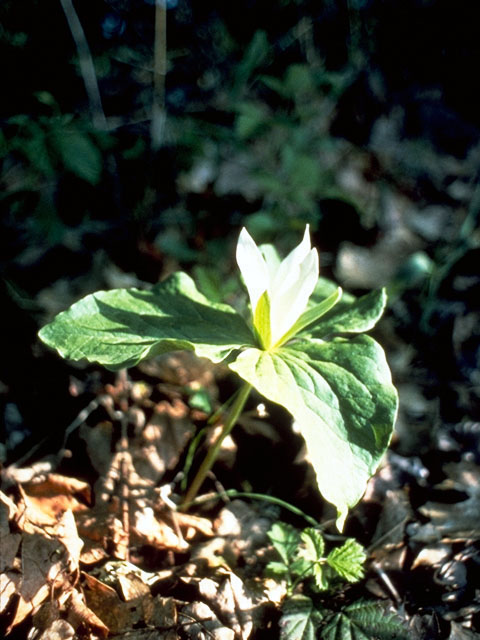
Trillium chloropetalum, the sessile trillium or wake-robin, flowers in mid-March in the woods of western Oregon.  It blooms just before the start of the spring chorus of birdsong.  This plant's mottled leaves are  almost as showy as its greenish-white flowers, which don't open into broad showy blooms like the western trillium. Both species of trillium produce a seed with an eliasome, a fleshy body particularly attractive to ants who disperse the majority of the seeds.  Yellow jackets also disperse trillium seeds.  These plants are pollinated by beetles, bumble bees, moths, and the non-native honeybees.

I didn't find any published research on the sessile trillium, but the western trillium can live to be over seventy years old based on counts of the annual restrictions on its rhizome. It does not even begin to flower until its fifteenth year. Trilliums don't survive disturbances such as logging, and the increased numbers of mice associated with clearcut and edge habitat take a toll on their seeds.  Long-lived, slow-growing plants affected by human disturbance face an uncertain future.

Even so, the sessile trillium persists in some unlikely places.  Along the overlooked urban banks of a local river, a thin strip of trees between the pedestrian path and the water's edge ducks under a series of overpasses.  Scotch broom, English ivy, and Himalaya blackberry tangle old plastic bags, broken bottles, and other refuse in the understory.  Nobody looks to these places for conservation.  But sessile trilliums bloom here every spring, refusing to relinquish this patch of forsaken ground.

Trillium chloropetalum. Photo by Linda Hardie-Scott

They remind me of the hand-held candles used in protests and memorial services, the flame borne above a flimsy shield.  These past few weeks have been marked in the human world by much upheaval and anguish in many countries torn by civil war, government violence against the unarmed, and the disasters in Japan.  The Japanese ceremony of floating candle lanterns, Toro Nagashi, honors the dead.  The trilliums blooming in the local woods have their own purpose, but they are still bright spots of both hope and memory in these dark times.

Sunday, March 13, 2011

Liars, Cheats, and Moral Standing on Campus

Years ago I took an environmental ethics class in college.  One of the essays we read made the argument that cats cannot have moral standing because cats do not lie.  According to this line of thinking, moral standing belongs only to beings that can recognize the difference between what is real and what is not real.  A lie is a deliberate trip into an alternate reality, requiring advanced cognitive ability.  Moral standing therefore rests on advanced capabilities that belong to humans, not to animals such as sea cucumbers or wombats.  Cats give no indication that they engage in deliberate deception, therefore they have no moral standing.  Bad behavior such as pilfering food doesn't count. 

In my years of scientific training, I was indoctrinated against the sin of ever, ever projecting human thoughts, ideas, or emotions onto other animals, domestic or otherwise.  I still accept that the principle is basically sound.  It helps remind us that the perceptions of our fellow organisms are likely very different from our own.  Taken too literally, however, the doctrine denies us insight into our shared biology particularly with other social species.  In other words, cats might lie, but proving it is more than a little tricky in practice.  So much for determining the moral standing of cats, or any other organism besides ourselves.

I am delighted to report that eastern gray squirrels and scrub jays do in fact engage in deceptive behavior. Squirrels appeared to deliberately pretend to bury nuts in empty holes when other squirrels were around.  The researchers who study these sorts of things assume that this kind of behavior pays off as long as everyone steals and everyone cheats- which in the world of squirrels, appears to be the case.  Western gray squirrels haven't been examined for their honesty, but they probably do the same thing.

Photo: Dr. Lloyd Glenn Ingles. Copyright: California Academy of Sciences

Western scrub jays also deceive.  The jays buried food in trays of soft soil rather than pebbles if they thought another scrub jay was listening, but didn't make that distinction otherwise.  A jay that is hiding food and is caught in the act will move the food- if the jay has stolen other jays' caches.  Naive birds who have never had the opportunity to steal don't move their caches if observed by other jays.  Apparently, only sneaky jays worry about other sneaks. 

Photo: Dr. Lloyd Glenn Ingles. Copyright: California Academy of Sciences.

Which leaves us with some interesting questions: does moral standing therefore require possession of a brain designed to deal with complex social interactions?  And why should we think engaging in behavior most human value systems would consider unethical is necessary for moral standing? 

I always have enjoyed watching squirrels and jays, because they are so able to adapt to human disturbance and engage in their own business right under our noses.  College campuses and parks provide convenient settings for scientific observations on a daily basis.  In any case, the drama of social interactions with all their complexity, nuances, and even deception are played out not just among the humans around campus.  It seems that drawing the line between anthropomorphizing and conducting legitimate research may be much more difficult than we once thought.